Thursday, July 30, 2015

I'm Not Worried About the Drought

With an El Niño year looming I'm optimistically looking forward to a great ski season. Though the drought may be over shortly, we've still been doing our small part to reduce water use, cutting our yard watering by 40% since 2013. There's a lot of brown out there now. Other Californians now have about 30 gallons per day more from our common supply. You're welcome.

Just today I read a story about the impending disappearance of the Ogallalla aquifer east of the Rockies, due to the fact that plains farmers have been pumping water out of it 10 times faster than its natural recharge rate. That's just the latest in a regular drumbeat of scary stories about how, thanks to the tragedy of the commons (where no individual farmer has any incentive to conserve, because his neighbor's pumps will drain the same water source as his), the aquifers of the West will soon be gone. The other day someone brought up the seemingly outrageous amount of water used by almonds, and the fact that California farmers in some areas are still planting new trees, even as others have to let theirs die.

Someone else asked me recently whether I was worried. I'm not. It's a commonplace observation that urban users account for only 20% of the total water used in California. And much of that goes to water peoples' yards in the hotter inland areas. The densest urban areas account for a small fraction of the state's total. So we're really not at risk of running out in the parts of the state where people want to live and where most of the economic activity happens.

What might happen (unless the farmers can get past their libertarian principles and work together) is that some farms will be abandoned and some foods will get more expensive. Probably not by much, though. (Although California is now the almond capital of the world, it didn't used to be, and I don't remember almonds being unaffordable when they were part of my regular snack supply as an impoverished grad student in the early '80s.) But even if some items get much more expensive, for most of us and for most of these items, their cost is just not that big a part of our budget. (I know there are lots of food-insecure people out there. I don't think they're mainly buying almonds and local beef. There are many places in the world that can produce caloric staples cheaply, and we can import all that stuff. I'm pretty sure I read a year or two ago that much of our cheap ground beef already comes from South America.) If parts of the plains turn to desert and the western side of the Central Valley has to be abandoned for farming, so be it. Bummer for those independent-spirited farmers, but I don't see why urban Californians should be concerned, other than in the general sense of being sympathetic about someone else's misfortune.

People have this notion that we must "do something" about the drought. Well, in principle a long enough drought would make the urban areas uninhabitable. But we're pretty far from that scenario. In any case there's little we can or need to do about that long term right now -- we don't even know if it's coming. Urbanites can cut back on their water use, but that won't help the farmers. And if the farmers refuse to work together to make efficient use of their collective groundwater resource, they're the main ones who will suffer the consequences. Although California has new laws that will eventually limit and manage groundwater use, lobbying by agribiz produced legislation that doesn't fully take effect for another 25 years. If the primary victims of the drought don't want to work together to solve their problem, that doesn't make it my problem.

So my main worry is that the El Niño won't materialize, and it'll be another crappy ski season. Please don't hit me.

Friday, November 21, 2014

A eulogy for Tammy

In her classroom. Photo by Jennifer Kelleher, one of her students.
When Tammy was a baby, I played peek-a-boo with her and got big laughs. In memory, her laughter was already outsized.

When she was 3 she wanted to be a ballerina. I gave her my red plastic fireman's hat and told her that if she wore that she'd be even better: a ballerina clerk. She wore it for days.

Don't ask what it meant. It was just early days of brotherly torture. But she wasn't defenseless. When she was 9 or 10, I got on the phone extension while she was talking with a friend. She responded with one of the most devastating insults one could deliver in our house: she said I was just like Nixon because I bugged people on the phone.

I told her she should credit me for her great sense of humor on the grounds that she had to have one in order to survive being my little sister. But that was just more teasing. Even in the last year, as she fought the disease and suffered the effects of the treatment, she'd reward a phone call with laughs and without complaints.

Witnessing the outpouring of love and affection she's received over the last few months reminds me of a lesson of that great 20th century american philosopher, The Wizard of Oz. As he told the Tin Man: Your heart is judged not by how much you love, but by how much you are loved by others. (He also said that hearts will never be practical until they can be made unbreakable.) Tammy's small frame held a huge heart.

Rest in peace, Tammy.

Friday, December 13, 2013

Another way the World Can End

I just found this paper from 12 years ago by Dar and De Rujula. It's about another way life on earth can be (mostly) snuffed out and might also explain why there are no old advanced civilizations. It's another variant on the world ending in fire. And unlike extinction by giant asteroid, we don't have the technology to do anything about it.

Dar is at the Technion and De Rujula at CERN. Their paper looks at what happens when a gamma ray burst (GRB) goes off in our galaxy. A GRB, visible somewhere in the cosmos about 3 times every day, is thought to be either the dying blast of a high mass supernova, in which the core collapses to either a neutron star or a black hole or the merger of two neutron stars. In either case, the combination of high angular momentum, trapped magnetic field and extreme kinetic energies - comparable to the entire rest mass of the star or stars - results in a few-second long blast of energy beamed along the opposite poles of the rotating system. We see a fraction of this energy as gamma ray photons. These two beams are tightly collimated by a combination of magnetic fields and relativistic effects, with opening angles thought to be no more than a few milliradians. That's how we can see them all the way across the universe -- an appreciable fraction of the supernova's total energy goes into these tightly focused beams. When one of them happens to point in our direction, it's bright enough to outshine everything else in the sky at gamma ray energies, even from billions of light years away.

If one of these things goes off in our own galaxy, though, we could be in trouble. Anything sufficiently close - and the center of the galaxy, 25,000 light years away, is apparently, close enough -- gets blasted with radiation. For us, it's not the direct gamma rays that are the problem. Our atmosphere blocks those pretty effectively. GRBs weren't even noticed until the 1960s, when, during the cold war, the US launched satellites designed to detect nuclear bomb blasts. (Above ground tests were banned by treaty in the early '60s.) Being above the atmosphere, they could see the GRB gamma rays.

However, once the gammas (and any other cosmic ray stuff -- protons and heavier nuclei swept up in the blast) hit the upper atmosphere, their interactions with atmospheric atoms produce a copious shower of high energy particles. The result of this air shower is a flood of high energy muons. Muons are heavy enough to zip by atomic electrons without being significantly scattered or deflected, not affected by the strong interaction, making them highly penetrating, and sufficiently long-lived for most of those created in the upper atmosphere to reach the surface. In fact, several (created by ordinary cosmic rays) go through you every second as you read this. They pass easily through the lower atmosphere and hundreds of meters of water or rock, and deposit all of their energy along the way. This puts them in a really nasty "sweet spot" of particle properties to cause trouble. Protons, which are heavier, interact strongly with atomic nuclei and lose energy before reaching the ground. Electrons are so light that they get scattered before going very far. Neutrinos just zip right through everything without losing any energy. Other particles like pions (aside from being strongly interacting) are too short-lived to reach the surface.

The net effect from the muons is a ~10 second zap of high energy radiation deposited in anything on the earth's surface or in the shallower parts of the ocean. According to the paper, a GRB at the distance of the center of the galaxy would, if pointed right at us, have enough energy to sterilize the planet's surface. Thanks to associated cosmic rays, which would follow the initial gamma pulse for a few days, no part of the planet would be safe. Dar and De Rujula calculate that a person at sea level would receive hundreds of times the fatal dose of radiation. Only the hardiest, smallest or deepest ocean life forms would have a chance of survival. Also, just for extra fun, there'd be a global firestorm from the thermal pulse in the upper atmosphere, like in the asteroid strike scenario.

Because the gamma burst comes from a supernova, it should also be accompanied by a neutrino pulse, and these might precede the gammas by seconds or minutes, because they are produced early in the collapse and escape almost immediately. The neutrinos would be imperceptible except to a few large experiments like IceCube. It seems unlikely that, even if correctly interpreted, the warning would help anyone very much. The only place to ride out the initial radiation blast would be deep underground. And the surface that anyone who happened to be down in one of these mines (such as physics grad students minding an experiment) would return to would be sterilized by the blast and the firestorm. Life would survive in the deep oceans and also among smaller, hardier critters (like these) that are able to withstand and repair cellular damage.

The paper's authors calculate an expected rate for getting caught by one of these blasts at roughly once per 100 million years. The nearest star likely to undergo this kind of supernova is Eta Carinae, but apparently its spin axis isn't pointing at us, though it's expected to blow sometime in the next million years or so. There's been some speculation that one or more of the handful of mass extinctions seen in the fossil record was due to one of these events, with arguments recently made for one about 450 million years ago as a candidate. (Oddly, while there are several later papers on the same general subject, no one seems to reference this paper. I'm not sure if that means it's wrong or if this is some petty turf thing.)

Anyway, this is another interesting way for the world to end, up there with the solar system wandering into a black hole or metastable vacuum decay. Always fun to think about!

UPDATE: A new paper suggesting that GRBs make most galaxies inhospitable to complex life. http://physics.aps.org/articles/v7/124. Doesn't mention the muon shower effect though. In fact I haven't found a later paper that references the one at the top. Maybe there's something wrong with the calculations, but de Rujula is a big name, so I doubt it's egregiously wrong.

Wednesday, November 27, 2013

A pseudo-debate on GE salmon

Interesting "debate" between Paul Greenberg, an opponent of GE technology and Elliot Entis, the former CEO AquaBounty Technologies. They've used GE to create a faster-growing salmon, which is to be raised in large (inland) fish tanks on primarily plant-based feed (in contrast to conventional farmed salmon which requires primarily fish-based feed). I put "debate" in quotes because the nature of the discussion doesn't resemble a real discussion so much as a bout of eel-wrestling. Entis repeatedly shows Greenberg's claims to be either mistaken or internally inconsistent (e.g,. arguing for "sustainability" at the same time as opposing GE salmon that requires less fish-meal input per unit of output), at which point Greenberg just raises some other point, without ever providing a rebuttal. I don't see how anyone can read this and come away thinking that Greenberg has made a case.

For anyone going to the link and deciding tl;dr; here's a key exchange. The earlier back-and-forth concerns also questions of "ownership" of the breed, environmental impact, labeling and profit.
Greenberg: But what about the fact that traditional growers who may not want to farm with modified stock will find themselves at a competitive disadvantage. That they may in fact be obliged to buy salmon juveniles exclusively from AquaBounty. Is that ethical? Is that good for the world?

Entis: I am confused by your raising the question of ethics. Are you really suggesting that improving a product so that people will prefer it is unethical because people with an inferior product will be disadvantaged? Is that what you would have written when the first Model T rolled off the line and the horse and buggy industry cried foul? Your "ethical" objection can be raised against any new invention or product. Do I hope salmon farmers will buy the AquAdvantage eggs? Of course, and then the farmers, consumers, and the environment will benefit. I think that is pretty ethical. 
Greenberg: I suppose it depends on what your definition of an “inferior product” would be. I know you have absolute faith in the safety of your salmon, but others would rather take a longer range view and wait and see if it is truly safe. DDT and PCBs were once considered “safe” in the general marketplace. We only saw their profound impact on the environment decades later.

Entis: Paul how long is the long range? Ten years? A hundred? This argument is the refuge of those who would prefer that this fish and any product of biotechnology never see the commercial light of day.

Very little in our world is perfectly knowable, but over the years I believe that the systems for judging knowable risk have improved in quality and comprehensiveness. I also know that analysis of DDT, PCBs, and other chemical agents used in the past did not undergo 15 or more years of safety research, as has the AquaBounty salmon. I can also point out with no fear of contradiction that no fish has undergone as much testing and analysis as the AquAdvantage Atlantic salmon.
After this exchange, where pretty much every claim Greenberg makes has been countered, Entis asks whether his mind has been changed at all. Greenberg says, in effect, that nothing he learns about this could change his view. So much for open-mindedness.

Saturday, October 26, 2013

Does warning your daughter that sexual assault is a risk of binge drinking make you a "rape apologist"?

[Updated: Quote from an article by Slate's legal correspondent Emily Bazelon at the end.]

The interwebs have been lit up over the last couple of weeks about how to talk (or write) about "rape culture" and the hazards faced by women who get blitzed at parties. I gather from some of what I read that this has been an ongoing point of anger within a segment of the feminist community, but I was stunned at the outpouring of vitriol in response to a column by Slate writer Emily Yoffe, "College Women: Stop Getting Drunk" (title probably provided by her editor) with subtitle "It’s closely associated with sexual assault. And yet we’re reluctant to tell women to stop doing it." The article made many points that struck me - and from comments evidently a lot of other readers - as perfectly sensible, motherly advice. To wit: there are predatory men out there, and women who get drunk - especially to the point where they lose control - are putting themselves at risk of becoming rape victims. This seems no more controversial than telling kids to look both ways before they cross the street, but evidently there's a long history of some sort of feminist view that any advice to women about how to stay safe amounts to "apologizing" for or "denying" the "rape culture", victim blaming and slut shaming. Apparently the only correct way to talk about rape is to talk about the men who are raping. Parents should "tell their sons not to rape". But they should never ever warn their daughters about the risks of being incapacitated by drugs or alcohol. Because that's just blaming the victims.

I've read a bunch of these feminist manifestos, and I still don't get it. [I use the word "feminist" here as a shorthand for the people espousing these views. I consider myself a feminist in the sense that I don't think gender should be grounds for discrimination, and I want my daughter to find the world entirely open to her in every respect, unlike, say, the way it is for Saudi women. But that doesn't mean I haven't warned her about the risks of alcohol.] This hoo-hah came in the wake of the news of two teenage girls from a small Missouri town who went to a party at the house of some HS football players, got passed-out drunk, were raped by some of the boys, then dropped off at their homes (one semiconscious and unable to get in her front door on a freezing night). After a subsequent investigation by the police and local prosecutor, charges against the boys were dropped; the reasons are disputed, but I don't think anyone openly argues that what the boys did wasn't rape or was OK. The "rape culture" meme is, I think, about the macho jock culture that tells guys that anything they do to score is OK, including sticking it in a drunk passed out 13 year old. I'm pretty sure that's a real thing, not just a feminist fantasy. But it seems hard to argue that the bulk of society is OK with this kind of thing - people all over the world were shocked at the Maryville story. It's no more acceptable than was the Matthew Shepard murder in the late '90s or the bullying that pushed a S. Hadley, Mass. girl to suicide a few years ago. It's bad shit and pretty much everyone agrees that it's bad shit and we should keep working to keep it from happening again. Humankind being what we are, it seems unlikely that these efforts will ever be completely successful.

What doesn't always happen in these rape cases is for the justice system to punish the perpetrators. The feminist claim is that when it doesn't happen it's because police, prosecutors and judges don't take it seriously. That might also sometimes be true, though it seems uncontroversial that the lack-of-consent part of a rape conviction is going to be tricky to prove in situations where the woman can't recall exactly what happened, particularly since there's such a thing as consensual sex, sometimes after drinking. Obviously that doesn't apply to cases like Maryville, but that's not what's being debated. What many of these folks are saying is that drunk consent is not consent, period, end of story. I don't know what these people's experience of the real world is - how many times they've gotten it on with someone after a few drinks. I'm guessing it doesn't heavily inform their polemics. The criminal justice system is a very blunt instrument for "solving" the complexity of interpersonal relationships.

[A case that got Yoffe a lot of flack from the same merry band is one where a married woman wrote to her (as "Dear Prudence") about how she & her husband drank, then got into bed & started going at it but she doesn't remember everything and is now really upset. ("I liked it and went along, only to wake up in the morning and remember only half of it.") Yoffe's response was not sympathetic, except to the woman's husband. Apparently, though she should just have told the woman that yes, her husband is a rapist and she should divorce him. This woman is a rape survivor who is being slut-shamed by Yoffe. (There's a much more nuanced response by Lindsay Beyerstein here. Though I don't agree with everything she says, she shows much more sensitivity to the unusual aspect of the story than the rest of the dial-at-11 rants of outrage.)]

There's a lot more along these lines at the websites Jezebel, Feministing, Salon and even on Slate, where Amanda Hess wrote a piece subtitled "We can prevent the most rapes on campus by putting our efforts toward finding and punishing perpetrators, not by warning their huge number of potential victims to skip out on parties." The theme is that its so tired to be warning women about the risks of alcohol - they all have heard it a thousand times - and so the only thing that needs to be written about is how we're going to lock up all the rapists.

What all this seems to miss is the completely straightforward observation that it's a risky world out there right now. All the good intentions in the world about "changing the rape culture" don't change it tomorrow. As Yoffe says in her reply: "In the meantime, this weekend, some young, intoxicated women will wake up next to guys they never wanted to sleep with. I believe it’s worth talking about how keeping within a safe drinking limit can potentially help young women avoid such situations." A common thread I notice in many of the replies is how young the writers are. I'm guessing they don't have daughters yet, and aren't thinking about this issue from the very immediate perspective of their daughter's safety today and tomorrow. (Though one of the more ridiculous pieces is by Soraya Chemaly, who has young boys.) Their responses are purely political: to give safety advice to girls is a distraction from the only correct path, telling boys not to be rapists. Chemaly says "These are profoundly systemic problems, and this approach - taking up valuable time and space -  is counter-productive." Umm… there’s a lot of space on the internet. And “counterproductive”? It's not like we can't walk and chew gum at the same time.

This is a subject that seems to invite analogies in the blog comments, such as about not wandering into a bad part of town with $100 bills poking out of your pocket. (Which does seem to verge on telling women not to dress “seductively”, though that's not how it's meant.) But to continue the one that I started with: when we tell our children to look both ways before crossing the street – even though they have the right to be in the crosswalk and cars are required to stop for them, and this is the tenth time we've said it – are we being apologists and enablers of the car-centric aggressive driving culture? (Also, taking up valuable time!) Or are we just giving them utterly commonsense instruction in how not to get hurt?

[Update]
A month after the Yoffe article, Emily Bazelon, Slate's legal correspondent wrote another, using a study on underreporting of drinking-related rape as a basis to defend Yoffe from the PC gang. Closing paragraph:
In the vast majority of sexual assaults, Krebs says, the victim knows the offender. And sometimes she may not remember exactly what happened—because her memory is blurred by intoxication. That’s why Emily Yoffe called for rape prevention education that reaches women as well as men. Not instead of men—of course we need to make clear that men who force sex are fully responsible for their violence, no matter what the circumstances. But we also should treat women as fully capable of agency by giving them the information they need to understand that binge drinking is a risk factor for sexual assault. I’m the mother of sons, not daughters. It is absolutely my responsibility to teach my boys that there is no excuse—none—for having sex unless they can be absolutely sure the other person wants to. But if I had girls, I would want to open their eyes to the reality that drinking to the point of passing out will make them more vulnerable. That doesn’t mean blaming them. It means arming them.

Thursday, September 19, 2013

Hiking the Sequoia NP Five Lakes Loop

I spent 4 days last week hiking a loop in Sequoia National Park, with Chris King. We covered about 31 miles, averaging 8-9 miles / day for the first 3, then 5 miles out on the last.
We started from the trailhead just beyond the Mineral King ranger station. From here, every direction is up. The peaks and ridges are close in and high up on every side but the one we came up, a canyon with a 23 mile long one lane road from the little resort town of Three Rivers. We set out last Thursday morning (the 12th).
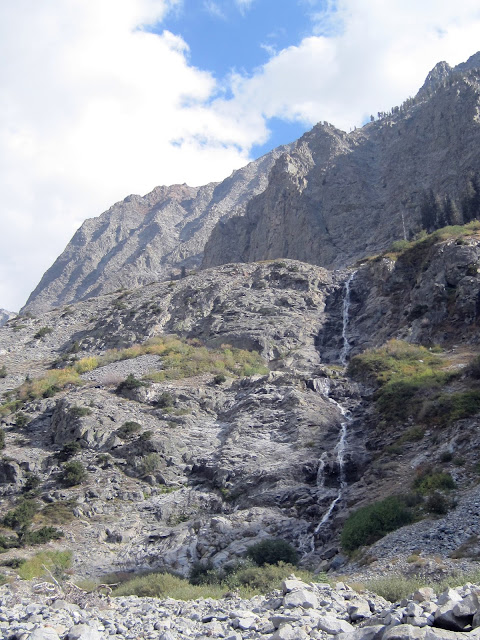
Timber Gap Trail
View from the Timber Gap trail, heading up from the Mineral King trailhead


After climbing out of the valley, we descended a wooded ridge. As we descended, we saw a helicopter below us, looking for a landing spot and descending below our sight in the canyon. Shortly afterwards we came on a small forest fire. About 15 x 30 feet next to the trail was smoldering, and flames were shooting up in a couple of spots. Hikers ahead of us had already started putting it out, and almost immediately a park service fire fighter from the helicopter showed up & took over, single-handedly putting it out with a shovel and a water-carrying backpack which he had to descend a mile or so to fill, before climbing back up to douse the embers. Much later we saw large gouts of smoke rising from the ridge. At first we thought the fire had grown, but soon realized that we were just seeing the steam as the fire was put down.

After descending the ridge, we turned east along a creek. Our first camp was 3 miles up the valley, by the creek, near Pinto Lake. In the next campsite over was a park law enforcement guy named Brad. He had hiked in from the same trailhead and was heading for the next valley to the north to help another ranger pack up her summer home in the wilderness.
View from the Black Rock Pass trail, towards Spring Lake

The next morning we continued east up the valley, before turning north to climb the ridge in a series of switchbacks that, after 3000 vertical feet, took us through the Black Rock pass. Brad passed us along the way, stopping briefly to take in iphone photo of a flower I wanted to identify. He promised that the ranger at Little Five Lakes would know what it was, or find it in her book. As we climbed, the glacial valley we had left came into full view and eventually we could look down on three hanging lakes feeding the creek, Spring, Cyclamen, and the uppermost one, Columbine, which we would eventually reach the next day. We could have just hiked there directly around the upper end of the valley, going off-trail to make a route shorter by a day.

From the top of the pass, around 11,600', we looked down to the north into the Little Five Lakes basin, a moonscape of mud-puddle lakes and scree. The ranger's summer yurt is visible just above the lake in the woods at high magnification in the image below. On the far side, a bit to the east is a high, imposing ridge of 12-13,000' peaks, the Kaweahs.

Little Five Lakes basin

Descending, we passed the middle lake above, before reaching the more scenic wooded one on the left. The ranger's yurt was partway around the lake, and we decided to check it out. We found there not just Brad, but also an older, grizzled ranger who had also hiked two days in from his wilderness yurt in the Kern valley to help the local ranger Christina take hers down and winterize the site. On meeting her, we understood why these guys had both hiked for two days to provide assistance. Aside from showing us a blinding smile, she identified the mystery flower from her book, then wished us an enjoyable remainder of our hike.

Returning to the trail, we slowly ascended east through some rocky woods, before turning south and then descending a 30-switchback slope which took us to Big Five Lakes, where we spent our second night. Camping near us at the lake was a 20-something couple who turned out to be chemistry grad students at Cal. They became "The Chemists" in later conversation. As in, "See you on the trail, Chemists!"

As on the previous night, the weather was great and we got a few minutes of beautiful alpenglow at sunset. The nighttime temperature probably got down into the high 30s - perfect sleeping weather, if I was any good at sleeping on a 1 1/2" mat on hard ground.
Big Five Lakes at sunset
The next morning (day 3) we climbed up and around the ridge to the east of Big Five lakes, then dropped into Lost Canyon, heading more or less west towards our starting point. This was perhaps the most scenic part of the hike. A gentle creek winds along the middle, with high ridges on both sides and Sawtooth peak dead ahead in the distance.
Lost Canyon creek and Sawtooth peak


This fellow was fattening himself up for the winter, and stood up to get a good look as we passed by.

Marmot


Eventually we got most of the way to the far end of the valley, where we began a long climb up the south side, reaching Columbine lake about 900' later. Here we took our only "group" shot.
Columbine Lake, below Sawtooth peak

Continuing around the lake, we took a wrong turn in a wide ridge of boulders, gullies and peaks, before backtracking and discovering to our chagrin that we had another 500' or so of climbing to do, before we would reach the top of Sawtooth pass at 11,700', just to the right of the peak in the photo.
On the far side of Sawtooth pass is a steep descent across a long slope of scree consisting of sand mixed with boulders of varying sizes. We forgot the instructions of the ranger who'd written our permit, to first go north along the ridge before descending the switchbacks. So many people before us had taken random routes down the slope that we also took what seemed like the "easiest", most direct way down, through the scree. This was a mistake, because the sand-covered boulders along the way were slippery and treacherous. Eventually we crossed the slope and reconnected with the "official" switchbacks.

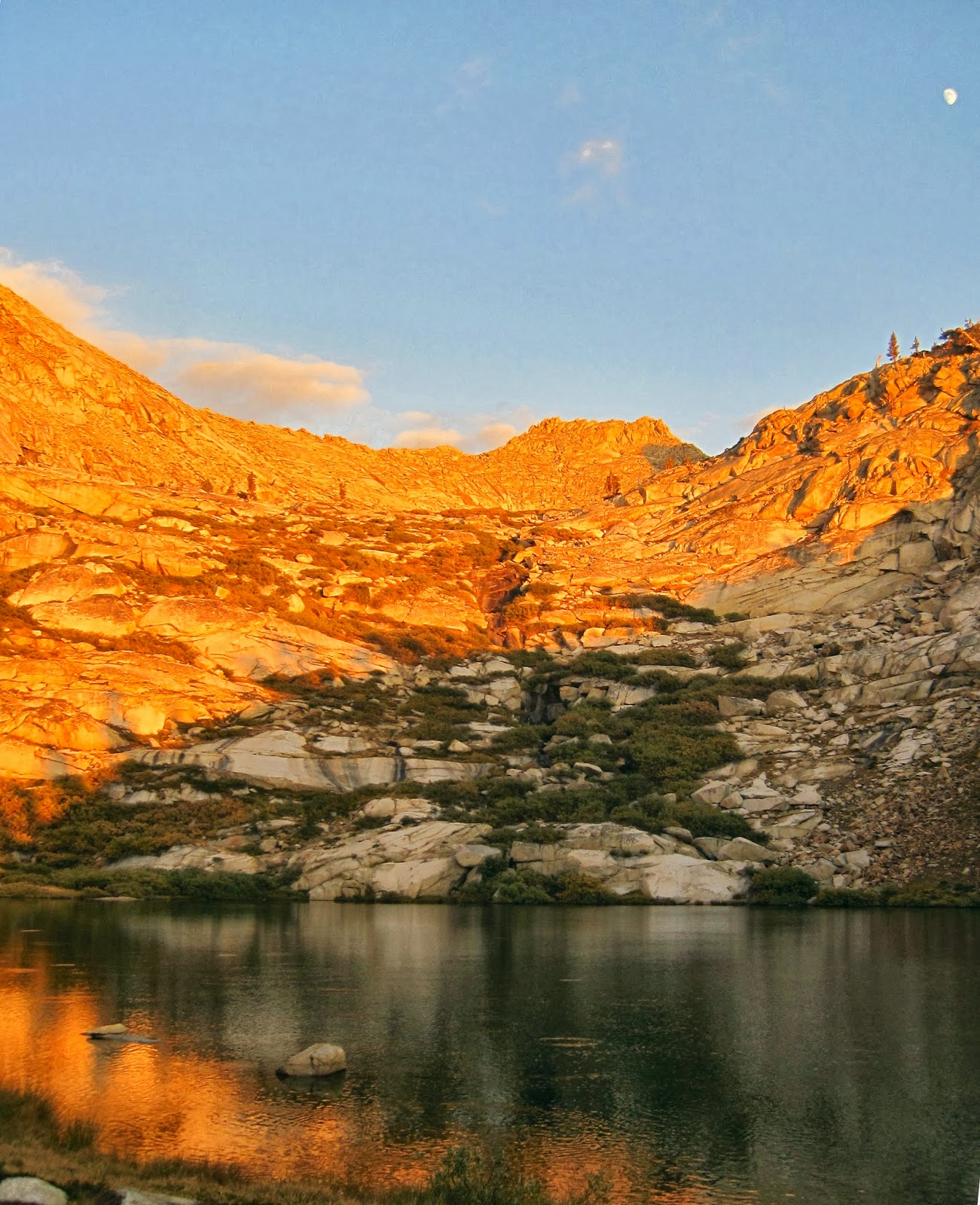
At the bottom of this slope, we hooked left and found Little Monarch lake. Being relatively close to the trailhead, this site was crowded with other campers by the time we arrived. We found a bare patch too near the lake, and pitched our tent. As the sun set the fish started jumping like mad. We had another perfect evening, with the moon rising above the cirque.

Monarch Lake sunset and moonrise


The next morning (day 4) we headed down through woods, eventually crossing a creek and reconnecting with the trail we had started on. A half mile later we were at the parking lot. Luckily, no marmots had eaten the engine hoses -- which apparently they do early in the summer, looking for salt. We headed back down the winding road and got on the highway.

Judging from the amount of water we saw, and reports from early-to-mid season hikers, we lucked out on the total absence of bugs. I never had to break out the 100% DEET I had brought. And the daytime temperature was perfect for hiking. I'm pretty sold on September trips.

Monday, August 26, 2013

Today's favorite sentences:
In 2012 alone, keas were responsible for $425 million in damages and 5 deaths. And while it’s true those statistics aren’t based on real data and that I just made them up, they are nonetheless startling.
http://www.lastwordonnothing.com/2013/08/16/snark-week-the-mighty-kea